Challenge
Connectors is a core product area of the Supermetrics Hub, enabling customers to build and manage custom data connectors to bring all marketing data into one place. As the product designer for this business pillar, my brief was to shape how Agentic AI could be integrated into the connector building feature (beta) and make it self-serve experience for GA.
The business impact of this initiative is significant — by enabling customers to build connectors independently without the traditional request and support model, the delivery process could be shortened from weeks to hours, with an estimated ARR of $4M.
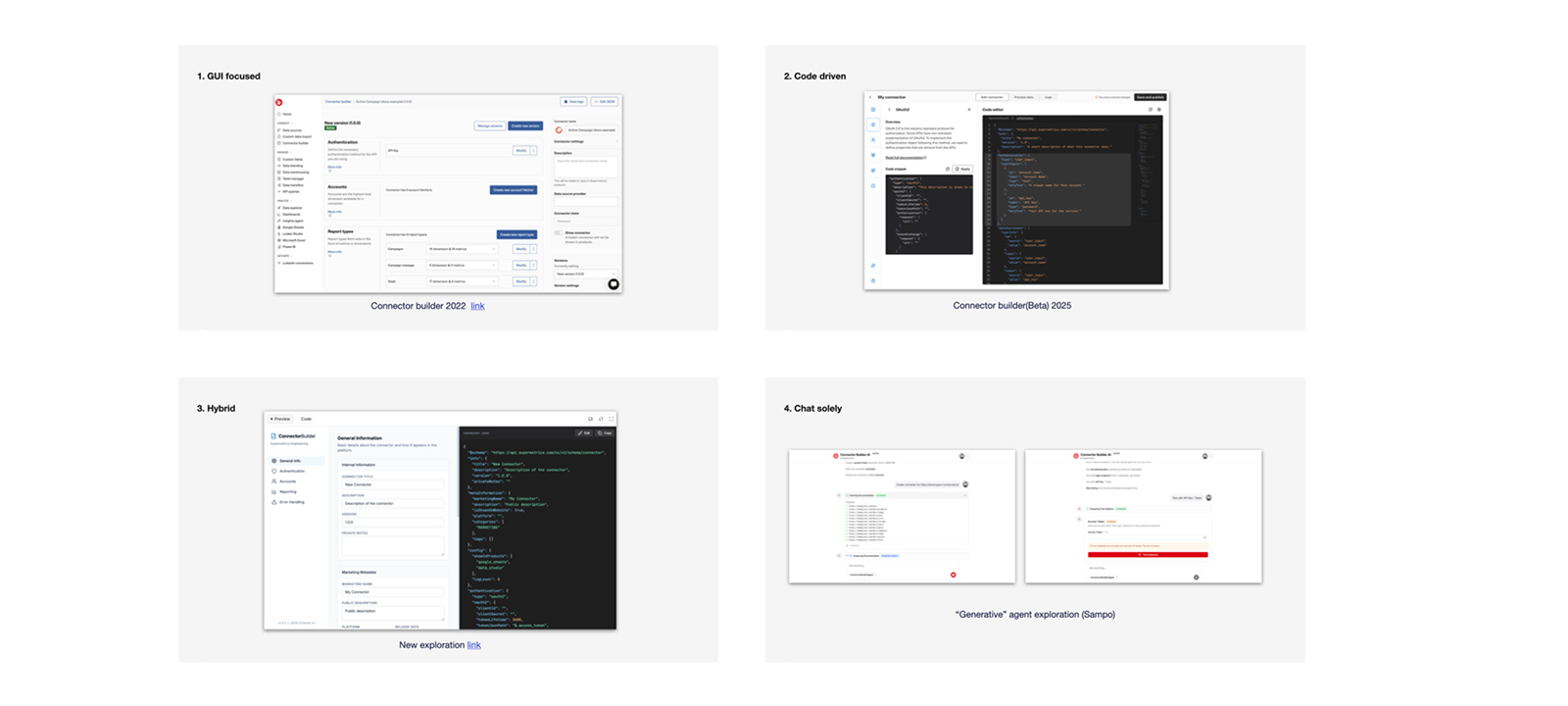
The biggest challenge was that during exploration phase, there were diverging ideas from the team and senior leadership pointed in different directions, with no agreed definition of the core problem or the right use cases for agentic capabilities. Moreover, with the added pressure to serve both technical users and a much broader audience simultaneously, the risk was a solution that compromised for all and truly served none.
The business impact of this initiative is significant — by enabling customers to build connectors independently without the traditional request and support model, the delivery process could be shortened from weeks to hours, with an estimated ARR of $4M.
The biggest challenge was that during exploration phase, there were diverging ideas from the team and senior leadership pointed in different directions, with no agreed definition of the core problem or the right use cases for agentic capabilities. Moreover, with the added pressure to serve both technical users and a much broader audience simultaneously, the risk was a solution that compromised for all and truly served none.
Impact
By grounding the team in shared insights from customers and internal test users, three key agentic AI opportunity areas and use cases are defined in a collaborative manner, and later translated into a two-horizon design output: a long-term product vision mockup and a pragmatic short-term wins detailed design that enabled the team to ship agentic value incrementally. Both outputs were well received by stakeholders and gave the team a clear, actionable path forward.
Alongside this, the agentic UX patterns was documented in md. and static format and shared across the design and product as a reference to drive a cohesive experience.
Alongside this, the agentic UX patterns was documented in md. and static format and shared across the design and product as a reference to drive a cohesive experience.
Long-term product vision
Establish a shared direction through research and data
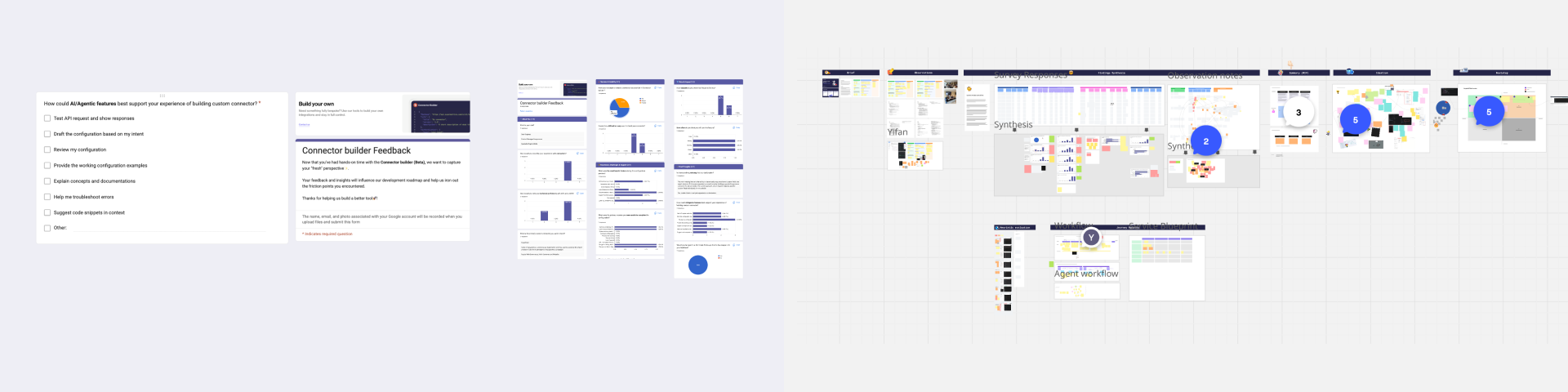
With competing ideas and no established baseline, I leveraged an internal training workshop to gather feedback on the beta version — the first time the wider team had seen it in action. To be more specific, I called for team members to join as observers and prepared an observation plan, and followed up with a targeted survey for all participants, capturing both real-time behavioural observations and reflective feedback on friction points, value, and where AI could help. To supplement in the initial findings, I also sent out survey to customers and did interviews and plus heuristic UX evaluation on the current solution.
The findings revealed that while the beta version was technically functional, it fell short of being a true self-serve experience/ Key gaps in the customer journey were identified, along with three clear opportunity areas where agentic capabilities could meaningfully simplify and elevate the connector building experience.
The findings revealed that while the beta version was technically functional, it fell short of being a true self-serve experience/ Key gaps in the customer journey were identified, along with three clear opportunity areas where agentic capabilities could meaningfully simplify and elevate the connector building experience.
Competing ideas and directions
customer centric and collaborative scoping
Translate insights into a two-horizon product vision
To accelerate the connecting phase, I leveraged Claude to vide-code the prototype to bring the concepts to life quickly and collect early feedback from the product team and key stakeholders. The aim was to achieve visual parity between the static designs and the coded prototype, though some corners had to be cut due to the maturity of our design system and component library.
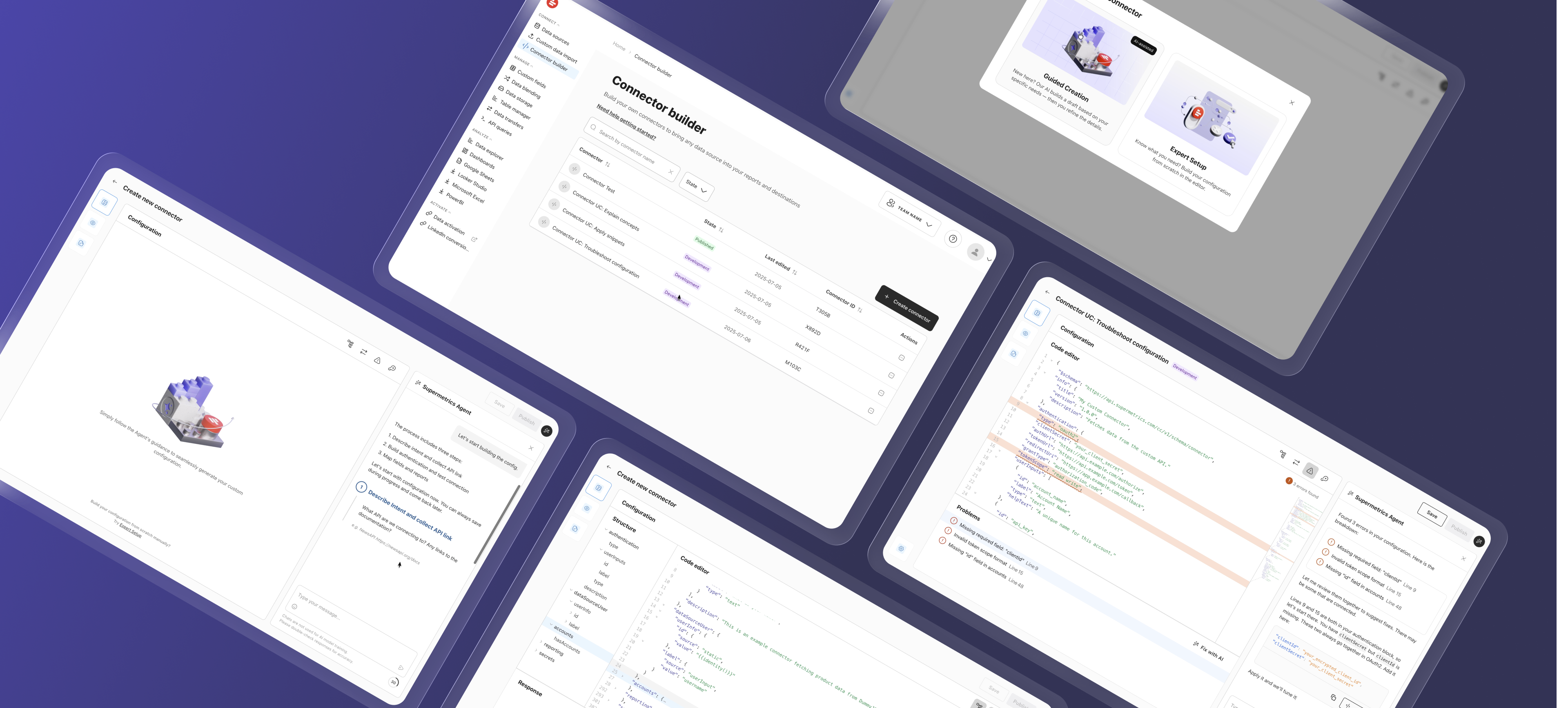
The design output was structured into two horizons — starting with quick wins to ship value immediately, and building toward a longer-term vision as the technology matures.
The design output was structured into two horizons — starting with quick wins to ship value immediately, and building toward a longer-term vision as the technology matures.
Horizon 1: Integrating agentic chat into the existing builder
The near-term output builds on the current connector builder by introducing an agentic chat panel directly into the existing interface, while the developers work in parallel on building out the agent framework (Google ADK) and training the agent for context awareness. This horizon targets two key opportunity areas: helping users understand concepts and terminology, find relevant snippets, and troubleshoot errors. To lower the barrier to engagement, suggested use cases are surfaced on the onboarding screen as conversation starters.
Horizon 2: A guided, AI-assisted experience built for everyone
The longer-term vision proposes a new information architecture that streamlines navigation and resolves suboptimal interactions. Extended console features are introduced to close the workflow gaps identified in the research, giving users all the tools needed to complete their job-to-be-done without leaving the platform.
At the core of this horizon is an AI-assisted connector building process designed to cater to a wider audience, making it easy for anyone to build a connector. The process is streamlined and structured around two key milestones that reflect the user's mental model: getting authentication to work, and refining reports. The result is a guided experience that is intuitive, accessible, and aligned with how customers naturally think about the task.
At the core of this horizon is an AI-assisted connector building process designed to cater to a wider audience, making it easy for anyone to build a connector. The process is streamlined and structured around two key milestones that reflect the user's mental model: getting authentication to work, and refining reports. The result is a guided experience that is intuitive, accessible, and aligned with how customers naturally think about the task.
Establish agentic UX guidelines to align the team and unify the experience
A core deliverable was a set of agentic UX guidelines covering interaction behaviours, agent response types, and design details — including dos and don’ts to help the team make consistent decisions. The intention was to establish shared practices across the team and build a consistent foundation for all agentic features, not just the connector builder. The guidelines were well received when shared with the team and have since served as a reference for ongoing development.